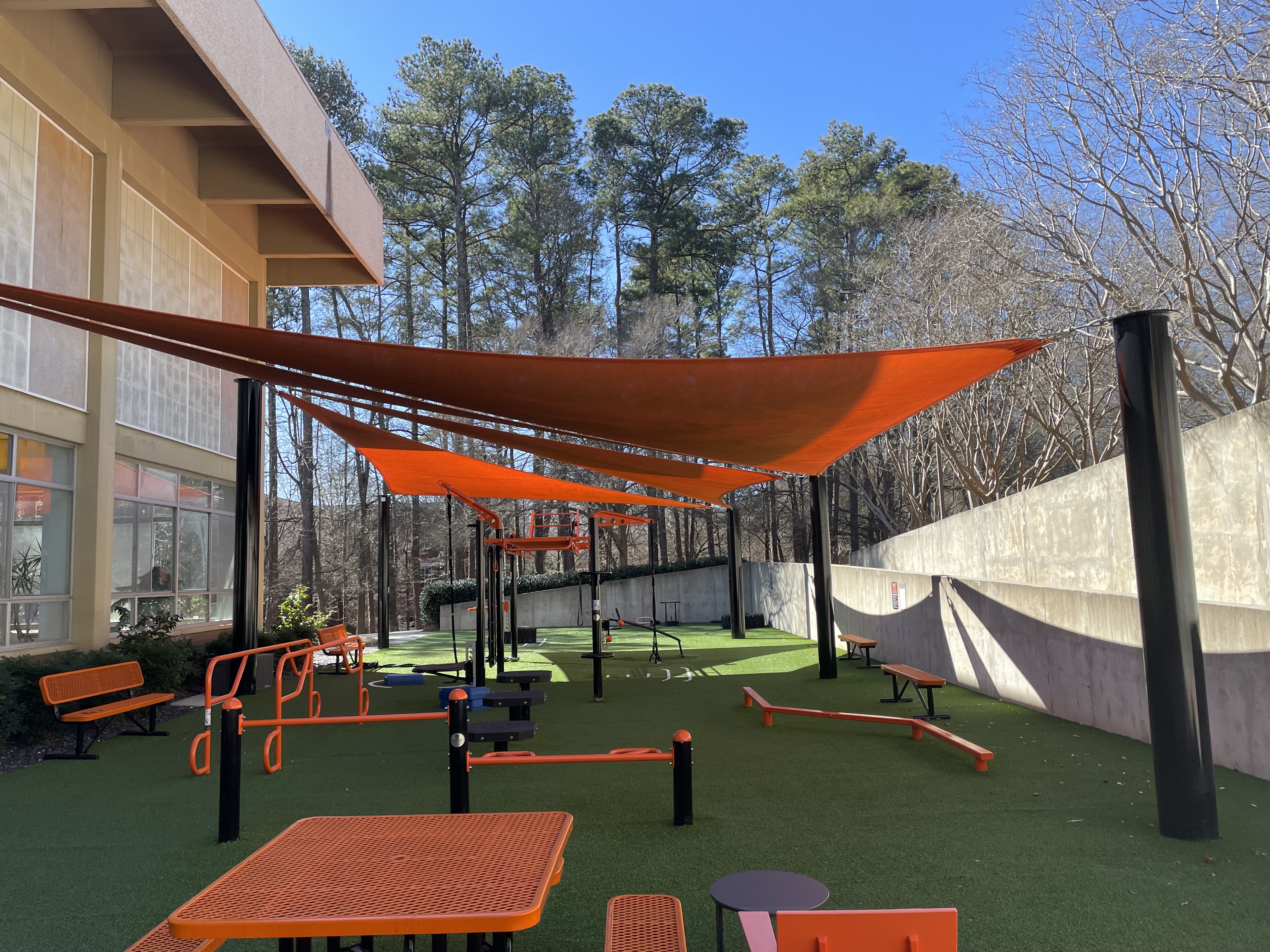
A shade structure has to hold up for years — through Georgia summers, spring storms and whatever the wind decides to do in August. That means safety isn't a checklist we run at the end of a build. It shapes which materials we spec, how we set footings, how the crew works around a school or a busy parking lot, and how we hand the finished structure over to you.

Industry best practices, start to finish
We strictly follow industry best practices to create secure, reliable shade structures. That starts with material selection — steel, fabric and hardware chosen for the span and the site, not for whatever is cheapest that week — and carries through every construction methodology we use on site.
In practice, that means the things you can't see once a canopy is up get the most attention: footing depth, anchoring, connection details, load paths. A shade sail looks simple from the ground. Everything holding it there is the part we obsess over.
- Materials specified for the structure, the span and the location
- Construction methods that follow established industry standards
- Anchoring and footing work sized for the loads the structure will actually see
- Every stage of the project reviewed with safety as the deciding factor

Rigorous training for every builder
Our team undergoes comprehensive education to stay current on the latest safety protocols. Codes change, equipment changes, and the right way to do something in 2026 isn't always the way it was done ten years ago — so training is ongoing rather than a one-time orientation.
The result is a crew that's prepared for the whole job, not just the parts they do most often. Working at height, handling steel, operating equipment, setting up a site so no one walks into a hazard: our builders are trained to handle all aspects of construction safely.
Our commitment to training ensures that our builders are well-prepared to handle all aspects of construction safely.

Regular safety audits on active sites
To maintain the highest safety standards, we conduct regular safety audits on our construction sites. Somebody walks the job and looks at it fresh — the staging, the barricades, the equipment, the work in progress — instead of assuming that because yesterday was fine, today is too.
It's a proactive approach. Auditing lets us identify and address potential safety concerns promptly, while they're still small and easy to correct, rather than discovering them after something has gone wrong. Most of what an audit turns up is minor. That's the point.

What safety looks like for schools, parks, lots and patios
The standards don't change from project to project, but the site conditions do — and that's where planning matters. Each of the environments we build in brings its own considerations:
- Educational institutions — work staged and secured so students and staff are never near an active build area, with structures engineered for daily use by children.
- Recreational environments — parks and public spaces stay usable, with clear separation between the public and the crew while we're on site.
- Commercial spaces and parking lots — traffic routing, vehicle clearance and pedestrian paths planned before the first post goes in.
- Residential — a tidy, contained work area on your property, with utilities located and protected before we dig.

When a project wraps, you get a structure that was built to be safe and a site left clean. Anything we spot during the audits gets handled before we call the job finished — we'd rather take an extra day than hand over something we're not confident in.

Have a question about how we'd approach the safety side of your project, or want to talk through a site that has some complications? Call Southeastern Shade at (404) 216-0036 and we'll walk through it with you.